
The Missing Layer in AI Agents: How to Actually Make Them Work Together

As autonomous agents move from labs to real-world deployments, the next major challenge is coordination. How do agents interact, communicate, and collaborate at scale — especially across different infrastructures, teams, and goals?
At Agents Day in ETHDenver, the panel "Coordinating Intelligence: The Future of Multi-Agent Collaboration in Decentralized AI" featured builders and researchers tackling these exact questions:
Mihir Kulkarni (Spectral Labs)
Harry Grieve (Gensyn)
Don Johnson (Virtuals Protocol)
Stepan Gershuni (cyber•Fund)
Moderator: Fraser Edwards (cheqd)
Here’s a breakdown of key insights for anyone working on multi-agent frameworks, infra, or agentic coordination layers.
⚡️ Agents Day is coming in hot — April 30, Dubai
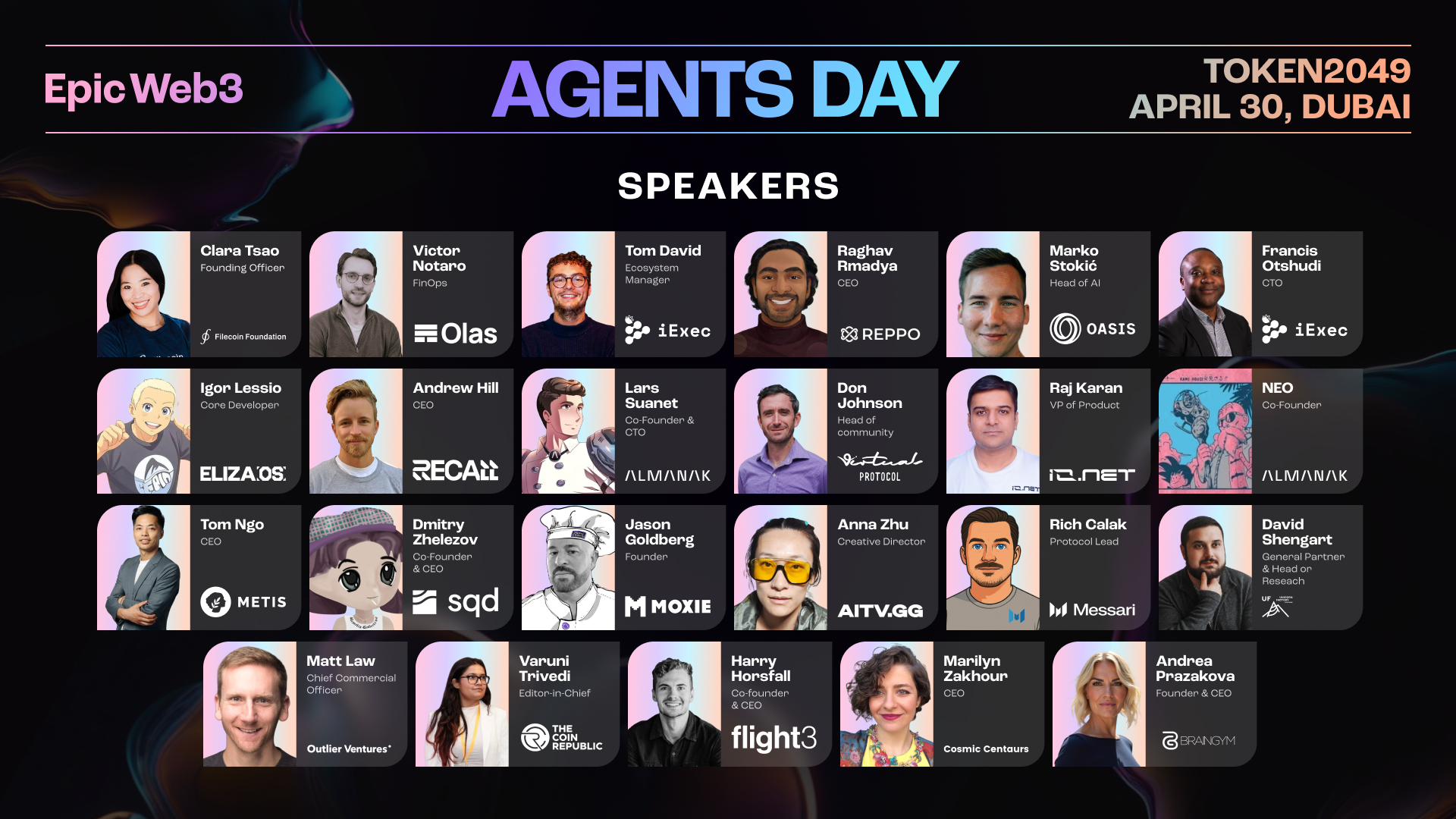
If you're heading to Token2049, join the biggest side event dedicated to the rise of AI agents. One packed day of real insights, no fluff. Expect sharp keynotes and panels on:
What makes AI agents trustworthy
How competition fuels scalable intelligence
Building and monetizing agent economies
DeFi + agents: use cases and new architectures
Infra for onchain autonomy
Speakers from: ElizaOS • Filecoin Foundation • io.net • Almanak • Virtuals Protocol • Olas • Recall • Reppo Labs • iExec • Metis • Oasis • Messari • AITV • Moxie • Subsquid • Outlier Ventures • Coin Republic • Unicorn Factory Ventures • Flight3
📅 April 30, Dubai, Token2049
🧞 The Oz city | pop-up village on AI + Web3
This summer, you can go from discussing agents to actually building them — surrounded by palm trees, founders, and 24/7 co-creation.


The Oz City is a one-week builder residency on the French Riviera, right before EthCC — focused entirely on AI, agents, and protocols.
📍 June 21–29, French Riviera (Valbonne, 20 mins from Cannes)
🏡 24/7 co-living & co-building
🧠 Agent Day, hands-on workshops, wellness, demo days
💸 Participation is free for builders!
🤖 Should Agents Declare Themselves?
There was no clear consensus on whether agents should always disclose that they’re agents — especially when interacting with humans. Some panelists argued that the distinction will blur as agents become more human-like, while others flagged the risks of impersonation and the need for authentication to prevent abuse.
The conversation highlighted the need for cryptographic authentication and agent identity standards to ensure transparency — especially in high-stakes interactions like financial coordination, governance participation, or customer support. Identity standards for agents will become essential.
🌱 Why Agent Diversity Matters
Agent ecosystems are trending toward specialization. Instead of one super-agent doing everything, systems are evolving into networks of smaller agents with unique roles.
Diversity improves problem-solving and resilience.
Specialized agents working together can outperform monolithic ones.
Mixture-of-experts (MoE) models or modular agent teams offer scalable alternatives to single-agent systems.
Diversity isn’t just a value; it’s an architecture strategy. Multi-agent collaboration leads to more powerful and efficient systems.
📡 Communication, Coordination & Challenges
The hard part isn’t making agents talk. It’s building:
Trust between agents and across devices
Protocols for coordination, task routing, and permission control
Interoperability across different frameworks and platforms
One major insight: coordination only works when metadata, secrets, and incentives are aligned. Think: agents hiring other agents, delegating authority, and sharing resources. Without orchestration protocols, multi-agent systems will stall.
Standardized agent-to-agent protocols, shared coordination layers, and permission primitives are critical next steps.
🔐 Trust, Verification & Reputation
Current verification models (like reputation scores) don’t scale well and are easy to exploit. Instead, panelists pointed to cryptographic proofs, tamper-evident logs, and hardware-level guarantees as more robust alternatives.
Agents should be auditable.
Logs must be reproducible.
Reputation must be tied to real task completion, not vibes.
Trust must be verifiable. Onchain audit trails, reproducibility, and device-level guarantees are more scalable than fuzzy reputations.
🧠 The Coordination Layer Is Missing
Multiple speakers pointed to the lack of shared standards for commercial interactions between agents. Today, agents lack shared protocols for discovery, negotiation, task contracts, or payments.
Existing protocols like Anthropic’s MCP show what’s possible, but lack economic and governance layers.
There’s a massive gap for agent-specific coordination tools — including task marketplaces, registries, and delegation frameworks.
The infrastructure to make agents commercially productive together is still early. This is a key frontier.
🌍 What Does Success Look Like?
The panel defined success as:
Agents representing a measurable share of global GDP
Fully autonomous companies or verticals
Safe, auditable agent commerce at scale
Failure mode? Over-centralization, lock-in by large entities, and regulatory shutdowns.
The long-term vision is cybernetic economies — open, permissionless agent networks coordinating economic activity with minimal human bottlenecks.
📺 Watch the full panel here:
That wraps it up for today! But before you go...
Check out our Twitter for more details. Follow us to stay updated on all the latest news!
Best,
Epic AI team.